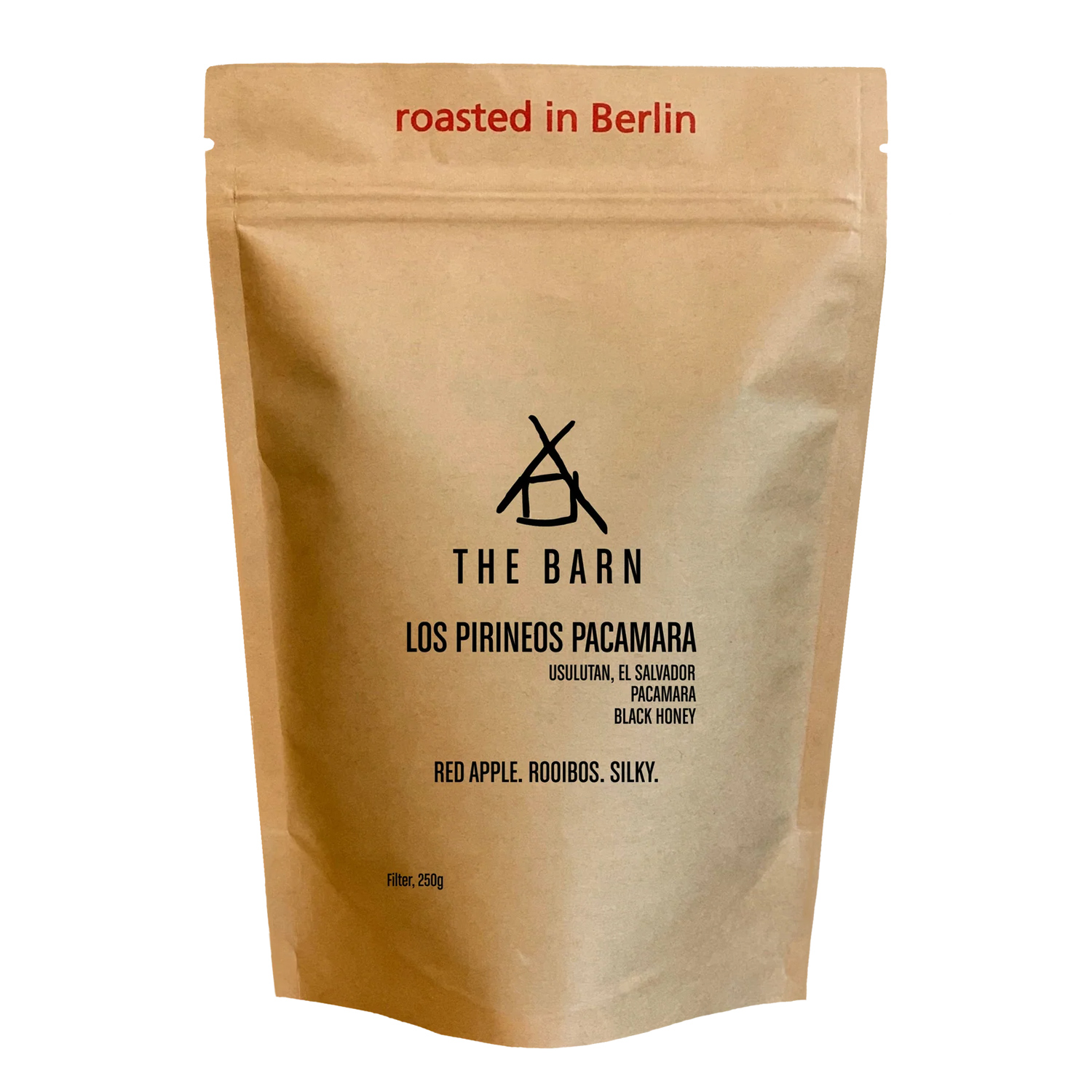
The Barn - El Salvador Los Pirineos Pacamara Black Honey Filter 250 g
Roasted by THE BARN in Germany
- Origin:
- El Salvador
- Process:
- Black Honey
- Variety:
- Pacamara
- Roast:
- Light
- Cupping score:
- 87.0
Tasting notes: red fruits, tea, honey, red apple
Where to buy
| Shop | Size | Price | Per 100 g | Stock |
|---|---|---|---|---|
| www.coffeedesk.com PL | 250 g | 20.7 EUR | 8.28 EUR | no |
About this coffee
Origin : El Salvador Region : Usulutan Farm : Los Pirineos, Diego Baraona Variety : Pacamara Processing : Black Honey Altitude : 1500 m a.s.l. Cupping score: 87 / 100 ABOUT THE COFFEE We love the large beans of the Pacamara varietal for their superb complexity. In the cup, expect refined fruit notes like red apple, and plum, alongside rooibos and milk chocolate. The body is silky, with honey-like sweetness. ABOUT THE FARM Gilberto Baraona was a shining beacon of the coffee industry in El Salvador. Over many years, he worked relentlessly to explore the possibilities of production, with a varietal programme that many dream of: the nursery that Gilberto developed hosts over 70 distinct coffee cultivars. Now in the trusted hands of his son, Diego, Los Pirineos continues to deliver the unexpected. At 1400 metres above sea level, Los Pirineos sits on volcanic slopes amongst lush forest. The microclimate around the volcano provides sun-filled days and cool breezes that are ideal for growing and drying. In the drying area of the farm, raised beds are positioned between two peaks which consistently channel the wind across the drying coffee. With twelve hours of sun per day, this creates an ideal environment for Honey and Natural processing. Quality and responsibility are central to the way Diego works. All the water used in processing is from collected rain, and bees are kept on the farm to help pollination across the farm and surrounding forest. With more than 60 employees, Diego ensures year round employment on projects across the farm. ABOUT THE PROCESS Our Pacamara lot underwent Black Honey processing. After harvest, ripe cherries are pulped but almost all of the mucilage is left intact. The pulped coffee is then spread in a thin layer on shaded raised drying beds. The shade slows the drying process compared to the other Honey processes used on the farm. Coffee is dried for approximately 25 days until it reaches ideal humidity and the mucilage has turned sticky and black, giving the process its name. ROASTER'S NOTE In a stunning volcanic landscape, fifth generation producer Diego continues the work of his father. Matching the Pacamara varietal with Black Honey processing delivers elegant fruit and silky sweetness. Store in a cold and dry space.